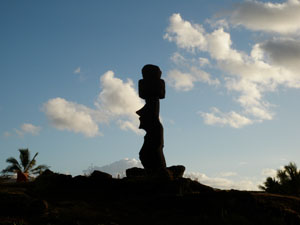
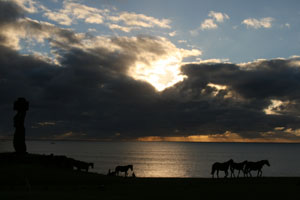
 "To me the island is not an image that repeats itself every second. Each place has an image that changes every second... now we are here and it looks like this, in a half hour it will look different.
 "There is a game between the clouds and the sun and the winds and the rains that are always changing - and that is what attracts me to loving this island so much."
Mike Rapu
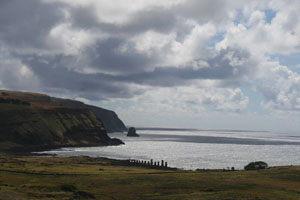 Rapa Nui, Easter Island, Isle de Pascua... the Navel of the World. The first impression I had of the island was of the light - the sensation that the sun was shining through the air, not just lighting the landscape, but lighting the air and the sky as well. It's a fairly barren piece of land - a little bump of volcanic rock and ash that began forming 3 million years ago - exposed to the elements, the wind, rain, sun, sea, shaped by the scarce plant and animal life that found its way there by air or by sea. And further shaped by the presence of humans since the first Polynesians landed on the shores sometime around the 700's.
The story of the people of the island, the Rapa Nui, is astounding. 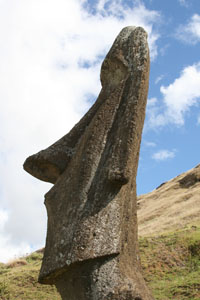 A society that grew from a handful of people that had traveled by sea, over 2000 miles from the nearest inhabited land, bringing with them, by boat, everything they need to start anew - plants, animals, tools and survival knowledge laced tightly with cultural beliefs. When the first people landed, the island was covered with lush vegetation, 70% of the land covered by palm trees and other native tree species.
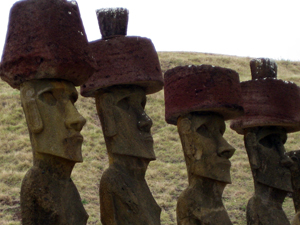 The island population peaked at around 14,000 people at the height of the Moai period. Twelve tribes across the island competed with each other for the diminishing resources, and the drive for dominance and prosperity among the tribes was most embodied by the obsession with erecting larger and grander Moia with each successive generation, appealing to the gods for protection of their villages and for the gift of life sustaining resources, and intimidating other tribes with their own displays of power.
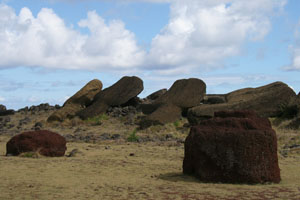 As the population grew, the food and resources became scarcer and the tribes waged war against each other - killing, cannibalizing, and destroying village structures... and the ultimate victory was in the toppling of the village Moia. These huge monolithic stone structures were pulled over, face down, as a symbol of victory. All of the Moia had been toppled by the mid 1800's.
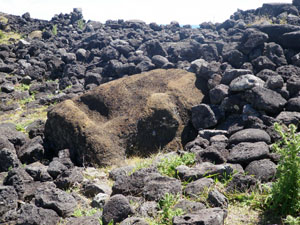 And every single tree on the island was eventually cut down - trees that were used to move the Moia statues from the quarry - Rano Raruke - where they were built, to the villages where they were erected. Trees, fibers for rope, human labor... all exploited in the quest for dominance, the obsession with appealing to the gods and honoring their tribal leaders. And the - desperation to survive on a tiny piece of earth where the human population outgrew the lands ability to sustain it. The people outgrew their 'planet' - they simply ran out of food and resources and as a consequence of their wars for dominance and survival, they destroyed everything that they once had.
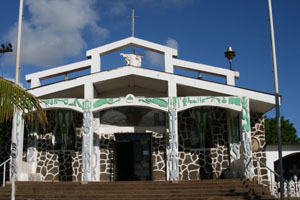 The 'discovery' of the island by Europeans was over a period of a couple centuries. First sighted by a Dutch explorer in 1722 on Easter Sunday (thus Easter Island). A brief landing and skirmish and no reason to stay (no supplies available for restocking) saw the Dutch leave within a week. A Spanish expedition in 1770 found the island, planted a flag, claimed the island for Spain, and then left. Four years later Captain Cook came to the island. The crew were sick and desperate for fresh water and supplies, but the islanders were also desperate. The ship soon left.
During the late 1800's Peruvian's were searching Polynesia for sources of slave labor (Peru had abolished slavery by then). Rapa Nui was a prime 'source' of human slaves since it wasn't under the protection of another country (such as French Tahiti). Over 2000 people were taken forcibly from the island to work the mines in Peru. Most of the people died in transit. A handful were eventually returned to Rapa Nui, but they brought back diseases such as small pox, and the remaining island population was further decimated. By the end of the 19th century only 111 native people survived.
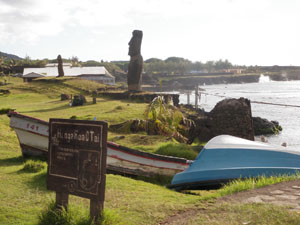 In 1883 Chile defeated Peru (and Bolivia) in the war of the Pacific, and Easter Island - Rapa Nui - was ceded to Chile. It was officially anexed. Chile had little interest in the island, there were no valuable resources, and in the early 1900's a Scottish/Chilean sheep and nitrate company, the Easter Island Exploitation Company, came to the island with the intent to raise sheep on the (now treeless) grasslands. The company herded all of the natives to the small harbor town, Hanga Roa, and kept them enclosed in the area by barbed wire perimeter fencing. Some of the older Rapa Nui still remember this time which lasted for generations, when they could not venture out on their own island.
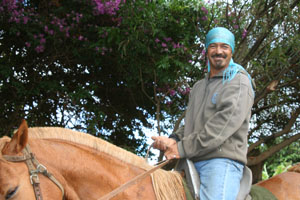 Today Rapa Nui is still a 'special territory' of Chile, sharing currency, language and some governmental authorities, but also has a degree of autonomy. Today only native Rapa Nui are allowed to own land, any outside development must be done through lease and contract, and the Rapa Nui are resentful and suspicious of outside influence. Tourism is becoming a major industry on the island (there is really no other significant industry) and the people want to keep as much control over this as possible.
It is a very interesting place - a cultural mix of Polynesian and Spanish - food, language, culture - a desire to protect the native cultures and language, and a need to embrace the modern world for survival.
more later-
Steph
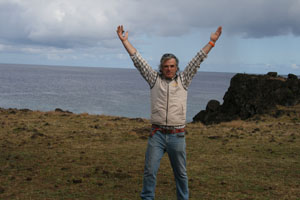
(Nirene - thanks for the photo!)
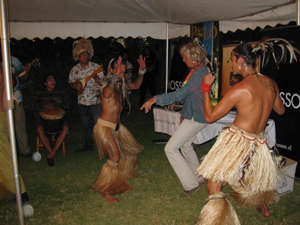

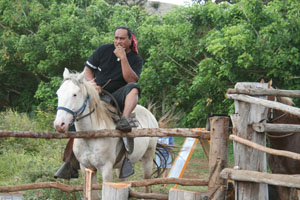 From everything I've seen and read and heard, this place is just now being discovered by tourists. It still feels very natural - the way it has been for decades. (tho as recently as 1960's the people were forced to live in a barbed wire enclosure and the "Easter Island Exploitation Company" - a Scottish/Chilean nitrate and sheep farming company, used the island as one big sheep pasture. The people were basically rounded up and confined to the area around Hauna Roa (the town/port) for several generations. The older islanders still talk about that time - where the sheep could come and go, but they couldn't. There's a fair amount of resentment by the natives. understandably. )
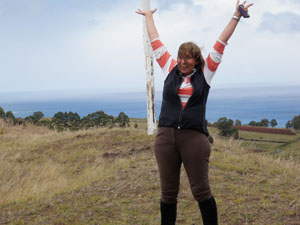 We went out to meet our horses this morning. There is a woman here from Zambia (born in England, now living in Africa) - she saw the EnduranceX ad on Endurance.Net - with a ride on Easter Island - and she made it happen. It was a dream of hers to go to Easter Island, since she saw a tv show on the island as a small child. Plus she's involved in endurance riding in Zambia and loves to ride. Zirene said "I had to go, to combine my dream and my passion" . That pretty much says it all!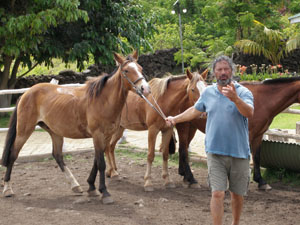
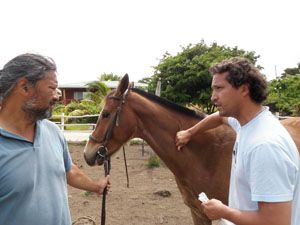 When we got back and unsaddled, a vet was there - researcher from University at Santiago - studying the horses here. Apparently somebody had the great idea to introduce a plant (lupine family) to help stabilize the soil. The plant is toxic to horses - alkaloids - and many of the horses on the island are getting sick. Affects their digestive systems, eventually liver failure. So many of the horses we saw on our drives were thin, listless (they become neurologically compromised as well) with bad coats, gaunt - these were apparently suffering from eating the plants.
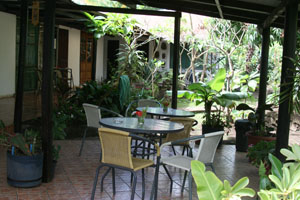 I landed at a sweet little hotel -
 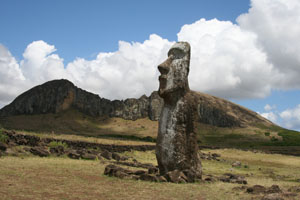 The locals, the Rapa Nui, are very distinctive. Tall in stature, the youth seem very athletic. Smiling, laid back, no worries. There are tourists - but nothing overwhelming. The island seems to absorb them easily. Most of the touring I've done I've been alone at the most incredible places - are maybe a couple other people coming through. Very spiritual here. The moai (statues) are unfathomable - huge, beautiful - and endearing! They feel more like friendly guardians than threatening guards. I'll try to write more about them when I get a chance - the how/why/when - some of which is purely theoretical (still un-answered questions) - some history they (anthropoligists, archaeologists) feel pretty certain about.
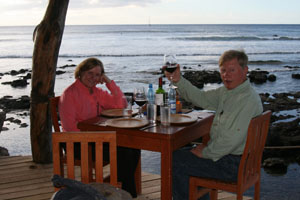 I've been having a great time with Steve and Dinah - they are so pleasant, and up for any adventure! We had a nice dinner at a restaurant - La Kaleka - right on the point of the harbour at Hauna Roa (the only town on the island). Enjoying a meal and a bottle of wine and a blazing sunset - as the surfers catch the waves, the fishing and dive boats going in and out. Todo bien.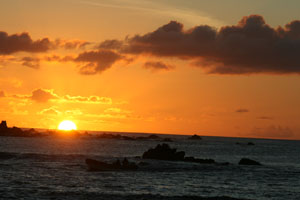
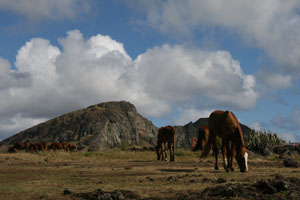 I joined them yesterday morning for a tour of the quarry - Rano Raruka - where they built the moai out of tuff - sedimentary stone formed from volcanic ash. Absolutely amazing - one of the most amazing feats of art and engineering you can imagine. They carved them all here, and then transported them to their tribal villages around the island. These things are huge and weight tens of thousands of tons - they used palm trunks and ropes to move them around. The moai that are still at the quarry are the last ones made - that were never finished or transported to their destination. Nobody knows exacly how/why the age of the moai ended!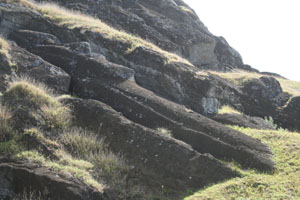
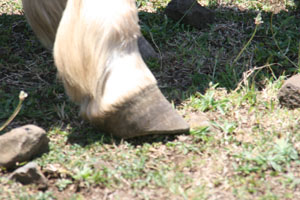 And the horses are all barefoot! (actually the vaqueros are barefoot too :). This is some of the stoniest land I've seen - the island is basically the highest point in an underwater mountain chain of volcanic eruptions. It's a rock island. I haven't seen the stable horse's feet yet, but I tried to get close to some of the feral-ish horses and their feet are amazing!! I can't wait to look at the stable horses more closely - I'll take some photos. This would be a fun place to study feet - the horses have never been shod, graze on the rockiest places you can imagine - sharp volcanic rock - plus they are ridden - a lot. Should be a lot of similarities with the western USA mustangs.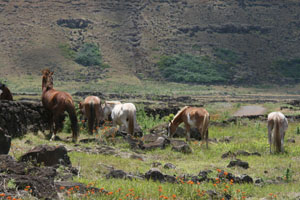
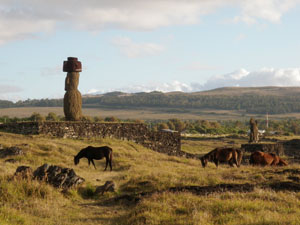 And today Sunday November 14 (I had to ask!) I landed on Easter Island, Isle de Pascua, Rapa Nui, El Ombligo del Mundo (the bellybutton of the world), the western most island of Polynesia. OMG I haven't been this excited on landing in a new place in a long time. This little island, population around 4000 I think, is the most geographically isolated, remotest place in the world. I watched a nice video on the plane, giving a taste of the history, culture, etc. The native population went from several thousand at its peak to only 111 individuals.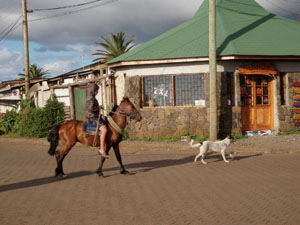
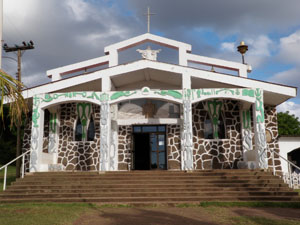
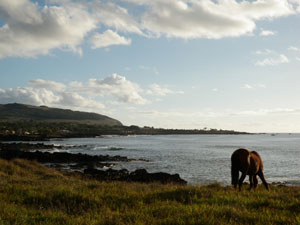 There were some tourists wandering around, plenty of locals on surfboards and riding their horses along the street. Dozens of fun little shops were luring me in!! Ican't wait to check out the local artisans. Dinner was some very good pizza at a little cafe, and am now sitting here on a little round plastic table and chair outside my room, it's getting pretty cool, there are a couple of cats to keep me company. All's well! (as I'm writing this I hear somebody riding down the dark street, clop clop, on horseback - there are horses everywhere).